

Corporate Governance
Last update: 27 March, 2026An overview of corporate governance.
AGC Group Corporate Governance Basic Policy last up date: 27 March, 2026
Corporate Governance Report last up date: 27 March, 2026
- AGCʼs Basic Approach to Corporate Governance
- The Four Pillars of Corporate Governance Initiatives
- Compensation System
AGCʼs Basic Approach to Corporate Governance
Under the AGC Group Philosophy “Look Beyond” , the AGC Group (comprising the Company and its subsidiaries) sets out “Our Purpose,” “Our Shared Values,” and “Our Spirit.” “Our Purpose” expresses the reason why we exist and the value we want to provide: “AGC, an everyday essential part of our world.”
The AGC Group creates additional value by providing safety, security, and comfort to society, creating new value and functions for customers and business partners and building trust with them, enhancing job satisfaction among employees, increasing the Group’s corporate value for investors, and building a better future for the coming generations. By delivering meaningful value for diverse stakeholders, the AGC Group seeks to achieve sustainable growth and increase corporate value over the medium to long term.
Corporate governance is a vital management foundation to realize these objectives, and the AGC Group is committed to continually pursuing an optimal corporate governance model for the Group.
The pillars of the AGC Group’s corporate governance initiatives are as follows:
- The Company respects the rights and equal treatment of shareholders and promotes constructive dialogue with them.
- The AGC Group promotes cooperation with a diverse range of stakeholders (including shareholders, investors, customers, business partners, employees, future generations, and local communities) and endeavors to build relationships of trust.
- The AGC Group ensures appropriate disclosure of information to stakeholders and ensures transparency in such disclosure.
- The Board of Directors and the Audit & Supervisory Committee of the Company (hereinafter, the “Board” and the “Audit & Supervisory Committee,” respectively) serve as the core of the corporate governance framework, make timely and decisive decisions, and exercise effective oversight and audit functions.
The Four Pillars of Corporate Governance Initiatives
Relationship with Shareholders
AGC Inc. respects the rights and equal treatment of shareholders and promotes constructive dialogue with them.
Investors ”To our Investors”
Policy on Constructive Dialogue with Shareholders
Investors "Corporate Bond and Rating Information"
Relationships with Diverse Stakeholders
The AGC Group promotes cooperation with a diverse range of stakeholders—including shareholders and investors, customers, business partners, employees, future generations, and local communities—and endeavors to build relationships of trust.
AGC Group Charter of Corporate Behavior
Management Policy AGC plus 2.0
Stakeholder Engagement
Sustainability
Information Disclosure and Communication
The AGC Group ensures appropriate disclosure of information to stakeholders and ensures transparency in such disclosure.
Disclosure Policy
Investors
Stakeholder Engagement
Corporate Governance Structure
The Board of Directors and the Audit & Supervisory Committee of AGC Inc. serve as the core of the corporate governance framework, make timely and decisive decisions, and exercise effective oversight and audit functions.
The AGC Group's Corporate Governance Structure(Outline)
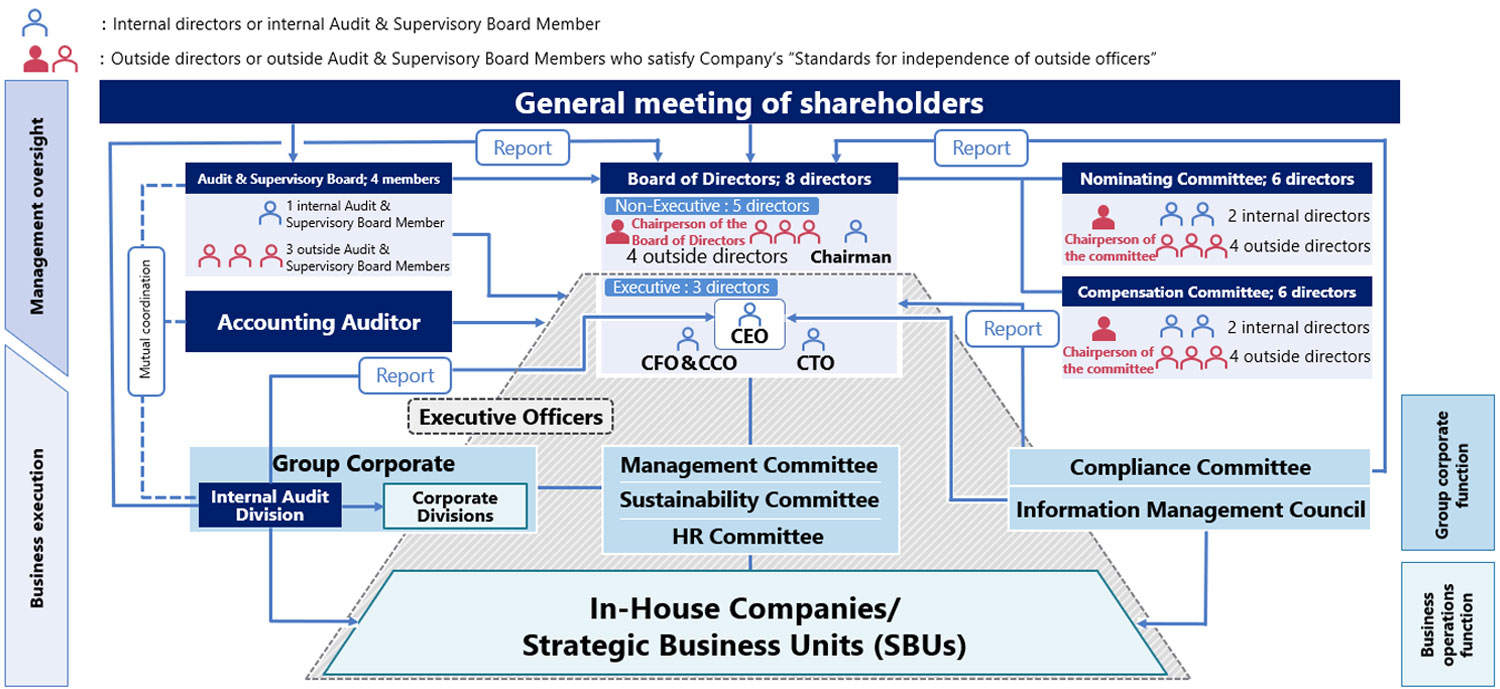
Approach to the Corporate Governance Framework
- As a company with an Audit & Supervisory Committee, AGC Inc. clearly separates the functions of management oversight and management execution: oversight is exercised by the Board of Directors, while management execution is undertaken by the President and CEO and other Executive Officers. The Audit & Supervisory Committee, as an independent body entrusted by shareholders, is responsible for audit and oversight functions in respect of the directors.
- Toward the realization of value creation, the Board of Directors defines its roles as setting the overall direction of management from a long-term perspective, encouraging appropriate risk-taking by management, and overseeing the realization of value creation, including evaluating the chief executive. The Board establishes a framework to maximize the effectiveness of these roles.
- The Board of Directors comprises a majority of independent directors and, in principle, is chaired by an independent director, thereby ensuring objectivity and transparency in its deliberations.
- The Board of Directors establishes voluntary advisory bodies—the Nominating Committee and the Compensation Committee—each comprising a majority of independent directors. These committees deliberate on matters including the appointment and dismissal (including succession planning) and remuneration of directors (excluding directors who are Audit & Supervisory Committee Members), directors who are Audit & Supervisory Committee Members, and Executive Officers, including the President and CEO, thereby ensuring objectivity, transparency, and accountability in decision-making procedures.
- By substantially delegating decision-making authority for management execution to the President and CEO and other Executive Officers, the Board of Directors focuses on oversight of management execution while ensuring agility in management execution by the President and CEO and other Executive Officers.
- In management execution, the Company adopts an in-house company system that clearly divides management into Group Corporate functions and business execution functions, thereby clarifying the scope of responsibilities and authorities, accelerating decision-making, and improving management efficiency. In addition, as advisory bodies to the President and CEO, the Company establishes a Management Committee, a Sustainability Committee, and an HR Committee (Human Capital Committee), which deliberate on matters relating to decision-making in management execution within the AGC Group and monitor business execution.
- The Audit & Supervisory Committee audits the performance of duties by directors (excluding directors who are Audit & Supervisory Committee Members) and contributes to the oversight function in respect of those directors. The Audit & Supervisory Committee and the Board of Directors establish a framework to maximize the effectiveness of these audit and oversight functions.
Oversight and Audit Framework
- Directors and the Board of Directors
- Composition of the Board of Directors
- The Company’s Board of Directors consists of no more than 15 directors. At present, the Board comprises a total of 10 directors, including six independent directors.
- To ensure the independence of its independent directors, in addition to the requirements for outside directors under the Companies Act, the Company has established its own Standards for Independence of Outside Officers, which are applied as the criteria for appointing independent directors. While transactional relationships exist between the Company and the companies to which independent directors belong, prices and other transaction terms are determined in the same manner as general commercial transactions.
- In principle, the chairperson of the Board of Directors is an independent director.
- Appointment of Directors
- Directors are appointed at the general meeting of shareholders. The appointment of directors requires the attendance of shareholders holding at least one-third of the voting rights exercisable by shareholders entitled to vote. Cumulative voting is not adopted.
- Term of Office of Directors
- The term of office of directors (excluding directors who are Audit and Supervisory Committee Members) is one year.
- Meetings of the Board of Directors
- In fiscal year 2025, a total of 14 meetings of the Board of Directors were held.
- Compensation
- The total amounts of monthly compensation, bonuses, and share-based compensation for directors are disclosed in the Business Report.
- The compensation system consists of fixed compensation (monthly compensation) and variable compensation (bonuses and share-based compensation).
- For directors who also serve as Executive Officers and for Executive Officers, compensation consists of monthly compensation, bonuses, and share-based compensation. For directors who do not serve concurrently as Executive Officers (including independent directors (excluding directors who are Audit and Supervisory Committee Members)), compensation consists of monthly compensation and share-based compensation.
- There is no retirement allowance system.
- Composition of the Board of Directors
- Nominating Committee
- Composition
- The Nominating Committee comprises a total of four directors, including three independent directors, with independent directors constituting a majority of the committee members.
- The chairperson of the Nominating Committee is an independent director.
- Members of the Audit & Supervisory Committee may attend meetings of the Nominating Committee as observers.
- Meetings of the Nominating Committee
- In fiscal year 2025, a total of 13 meetings of the Nominating Committee were held.
- Composition
- Compensation Committee
- Composition
- The Compensation Committee comprises a total of four directors, including three independent directors, with independent directors constituting a majority of the committee members.
- The chairperson of the Compensation Committee is an independent director.
- Members of the Audit & Supervisory Committee may attend meetings of the Compensation Committee as observers.
- Meetings of the Compensation Committee
- In fiscal year 2025, a total of six meetings of the Compensation Committee were held.
- Composition
- Audit & Supervisory Committee
- Composition of the Audit & Supervisory Committee
- Audit & Supervisory Committee comprises a total of four Audit & Supervisory Committee Members including three independent members.
- Appointment of Directors Who Are Audit & Supervisory Committee Members
- Directors who are Audit & Supervisory Committee Members are appointed at the general meeting of shareholders.
- The Audit & Supervisory Committee selects full-time Audit & Supervisory Committee Members by resolution. At present, there are two full-time Audit & Supervisory Committee Members.
- Term of Office of Directors Who Are Audit & Supervisory Committee Members
- The term of office of directors who are Audit & Supervisory Committee Members is two years.
- Establishment of the Audit & Supervisory Committee Office
- The Company has established an Audit & Supervisory Committee Office as an organization to assist the Audit & Supervisory Committee in the performance of its duties.
- Independence of Staff of the Audit & Supervisory Committee Office from Executive Directors
- Personnel transfers and performance evaluations of staff of the Audit & Supervisory Committee Office require the consent of the Audit & Supervisory Committee.
- Meetings of the Audit & Supervisory Committee (Audit & Supervisory Board in Fiscal Year 2025)
- In fiscal year 2025, a total of 14 Audit & Supervisory Board meetings were held.
- Remuneration (Remuneration of Audit & Supervisory Board Members in Fiscal Year 2025)
- Remuneration for Audit & Supervisory Board Members consists solely of monthly remuneration, and the total amount is disclosed in the Business Report.
- Composition of the Audit & Supervisory Committee
- External Auditor
- Appointment of the External Auditor
- The External Auditor is appointed at the general meeting of shareholders.
- The current External Auditor is KPMG AZSA LLC.
- Audit Fees
- In fiscal year 2025, fees paid to KPMG AZSA LLC, the External Auditor of the Company and its domestic consolidated subsidiaries, for services as defined in Article 2, paragraph 1 of the Certified Public Accountants Act (Act No. 103 of 1948) amounted to ¥240 million.
In addition, fees for services other than those specified above—namely, agreed-upon procedures—amounted to ¥7 million.- • Amounts are shown in units of millions of yen, with figures less than one million yen rounded down.
- In fiscal year 2025, fees paid to KPMG AZSA LLC, the External Auditor of the Company and its domestic consolidated subsidiaries, for services as defined in Article 2, paragraph 1 of the Certified Public Accountants Act (Act No. 103 of 1948) amounted to ¥240 million.
- Appointment of the External Auditor
Introduction of Executives
Compensation System
Amount of Compensation, etc. for the Directors and Audit & Supervisory Board Members for the Fiscal Year Ended December 31, 2025
| Number of recipients and amount of payment | Breakdown | ||||||||
|---|---|---|---|---|---|---|---|---|---|
| Fixed compensation | Variable compensation | ||||||||
| Monthly compensation | Bonus
(Amount of bonuses for the fiscal year under review) |
Stock Compensation | |||||||
| Number of recipients
(persons) |
Amount of payment
(¥million) |
Number of recipients
(persons) |
Amount of payment
(¥million) |
Number of recipients
(persons) |
Amount of payment
(¥million) |
Number of recipients
(persons) |
Amount of payment
(¥million) |
||
| Directors | 8 | 690 | 8 | 381 | 3 | 143 | 8 | 165 | |
| Independent Directors | 4 | 73 | 4 | 65 | - | - | 4 | 7 | |
| Audit & Supervisory Board Members | 5 | 104 | 5 | 104 | - | - | - | - | |
| Independent Audit & Supervisory Board Members | 3 | 68 | 3 | 68 | - | - | - | - | |
Policy for Determining Compensation and Other Emoluments for Officers
Compensation Policy
- Basic Philosophy on Compensation System
The Company sets out, as its compensation principles, its basic philosophies on overall compensation for officers as follows.
- The compensation system shall be one that enables the Company to attract, secure and reward diverse and talented personnel, in order to establish and expand the Company’s edge over its peers.
- The compensation system shall be one that promotes continued improvement of corporate values, and in this way allows shareholders and management to share gains.
- The compensation system shall be one that motivates the management to achieve performance goals relating to management strategies for the AGC Group’s continuous development.
- The decision-making process of determining compensation shall be objective and highly transparent.
- Composition of Compensation
- Compensation for the Company’s officers consists of “Monthly compensation” as fixed compensation and “Bonuses” and “Stock compensation (*1)” as variable compensation. The Company’s officers are eligible for the following compensation according to their positions.
Classification Fixed compensation Variable compensation Monthly compensation Bonuses Stock compensation Performance-linked component Fixed component(*2) Directors who serve concurrently as Executive Officers, and Executive Officers ○ ○ ○ ○ Directors who do not concurrently serve as Executive Officers,(excluding Directors who are Audit and Supervisory Committee Members) ○ - - ○ Directors who do not serve concurrently as Executive Officers (Directors who are Audit & Supervisory Committee Members) ○ - - - - (*1) In the event that persons eligible for Stock Compensation are non-residents of Japan, the Company may, instead of delivering shares, make a cash payment in an equivalent amount as a bonus payment to such persons.
- (*2) The fixed component of the stock compensation is not linked to the Company's performance.
- The proportion of each component of Directors based on the standard payment amount shall be approximately as follows (*3), and especially the variable compensation shall be determined by reflecting details of (3) Scheme of Variable Compensation” below.
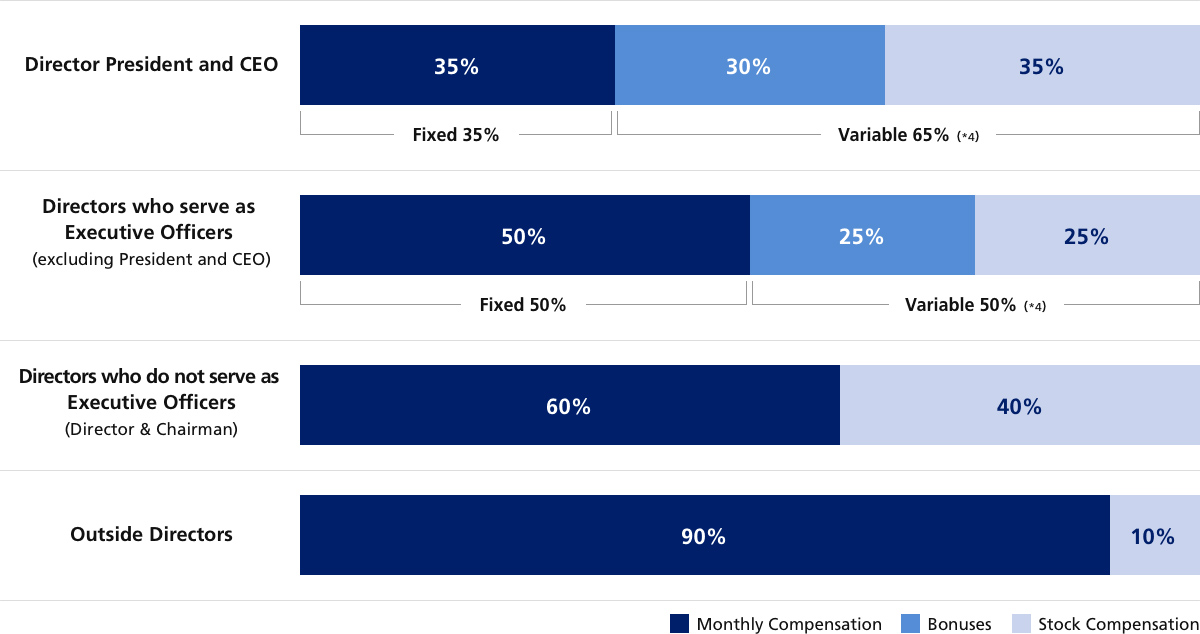
- (*3) If an officer does not fall under any of the classifications, the matter shall be deliberated by the Compensation Committee and approved by the Board of Directors.
- (*4) Variable compensation shall be the total of bonuses and amount of stock compensation for a single fiscal year.
- Compensation for the Company’s officers consists of “Monthly compensation” as fixed compensation and “Bonuses” and “Stock compensation (*1)” as variable compensation. The Company’s officers are eligible for the following compensation according to their positions.
- Scheme of Variable Compensation
Variable compensation takes into account a balance among each of short-, medium-, and long-term periods, to allow management functions to be carried out from a well-balanced perspective in each term, in order to achieve sustainable growth and enhance the corporate value of the AGC Group.
- Bonuses
- An amount according to each officer’s position is adjusted in accordance with the consolidated performance indicators for a single fiscal year, in order to further enhance the motivation to achieve performance goals for a single fiscal year.
- The indicators of performance shall be Return (Operating Profit) on Capital Employed*5 and Cash Flow, considering the importance of improving business profitability and asset efficiency, as well as generating cash flows.
- (*5) Return (Operating Profit) on Capital Employed = Operating Profit/Operating Assets
- The payout % shall vary depending on the level of achievement of the target for Return (Operating Profit) on Capital Employed and improvement of Cash Flow compared to the previous fiscal year. In principle, the payout % shall vary between 0% and 200% of the standard payment amount, taking into account company-wide performance, reinforcement of non-financial capital, progress in portfolio conversion and other conditions, as well as individual performance. The payout % shall be determined by a resolution of the Board of Directors after deliberation by the Compensation Committee.
- Bonuses cover the period from the beginning of the fiscal year to the final day of the fiscal year, and are paid immediately after the first annual general shareholders' meeting held after the end of the target period.
[Results for the Fiscal Year Ended December 31, 2025]
- With respect to the operating profit margin on operating assets indicator, the actual result was 5.4% (adjusted value) against a target of 6.9%.
- The cash flow indicator showed an increase compared with the previous fiscal year.
- Based on the above two indicators and the Company‑wide special evaluation, bonuses for directors who concurrently serve as Executive Officers were paid at 100% of the standard payment amount.
[Targets for the Fiscal Year Ending December 31, 2026]
- With respect to performance indicators, in light of the importance of enhancing business profitability and asset efficiency while generating cash, the Company adopts operating profit margin on operating assets and cash flow as the relevant indicators.
- Stock compensation
- The Stock compensation plan (the “Plan”) is intended to enhance the motivation to contribute to medium- to long-term improvements in the corporate value of the AGC Group, and to promote a sharing of interests with shareholders, as well as to further enhance the motivation to achieve the performance goals in the mid-term management plan (the “mid-term plan”).
- Compensation under the Plan consists of a performance-linked component, whereby the Company’s shares, etc. to be delivered will vary depending on the position and the level of achievement of targeted consolidated performance indicators for the mid-term plan, and a fixed component, whereby a fixed number of the Company’s shares, etc. shall be delivered in accordance with the position.
- The performance indicators shall be (i) ROE and (ii) EBITDA as financial indicators, (iii) Relative TSR (vs TOPIX) as stock price indicator, (iv) GHG emissions per unit of sales and (v) Employee engagement as non-financial indicators.
(Performance Indicators)
Category Performance Indicators Reason for Selection Weight Financial Indicators ROE Important Performance Objectives for Long-term and Medium-term Plan Periods 30% EBITDA To improve cash generation capacity and profitability 30% Stock Price Indicator Relative TSR
(vs TOPIX)More profit sharing with shareholders 20% Non-Financial Indicators GHG Emissions per unit of sales Aiming to contribute to the realization of a sustainable global environment 10% Employee Engagement Aiming for the growth of the company through the growth of each employee and the exercise of his or her abilities. 10% - In principle, the “performance-linked component” shall vary between 0 to 200% of the standard payment amount, depending on the degree of achievement of the targets for each indicator, and shall be determined by a resolution of the Board of Directors after deliberation by the Compensation Committee. The degree of target achievement shall be calculated as follows.
- a. Financial indicators: Calculated by weighting the degree of achievement against targets for each fiscal year of the mid-term plan, by a predetermined ratio (*6).
- b. Stock price and non-financial indicators: Calculated based on the degree of achievement against targets as of the end of the mid-term plan.
- (*6) 25% for the first year, 25% for the next year, and 50% for the final year
- Officers shall continue to hold the Company's shares acquired through this plan until they retire from the Company.
[Results for the Fiscal Year Ended December 31, 2025]
- With respect to ROE, against a target of 8.4% for the fiscal year ending December 31, 2026, which is the final year of the Medium‑Term Management Plan (as initially set at the time of formulation of the Plan), the actual result for the fiscal year ended December 31, 2025, the second year of the Plan, was 4.7%.
- With respect to EBITDA, against a target of ¥441.0 billion for the fiscal year ending December 31, 2026, which is the final year of the Medium‑Term Management Plan (as initially set at the time of formulation of the Plan), the actual result for the fiscal year ended December 31, 2025, the second year of the Plan, was ¥307.3 billion (calculated on a simplified basis as operating profit plus depreciation and amortization).
- Bonuses
- Compensation Level
The Compensation Committee verifies the level of compensation for the Company’s officers by analyzing compensation data of major manufacturing companies obtained from the data compiled by a third-party organization and comparing the said data with the Company’s compensation level.
Compensation Determination Method
The Compensation Committee is a voluntary advisory committee chaired by an Independent Director; the majority of whose members are Independent Directors. It deliberates on matters such as the compensation system and the level of compensation of Directors and Executive Officers, based on “(1) Basic Philosophy on Compensation System”, and makes proposals for a resolution of the Board of Directors. Compensation of Directors (excluding Directors who are Audit & Supervisory Committee Members) shall be resolved at the Board of Directors, within the maximum amount of compensation (total amount) approved at a general meeting of shareholders. The Compensation Committee also verifies the results of compensation payments. Likewise, compensation for Directors who are Audit & Supervisory Committee Members shall be determined through discussions among Directors who are Audit & Supervisory Committee Members, within the maximum amount of compensation (total amount) approved at a general meeting of shareholders. Through such procedures, the Company enhances the objectivity and the transparency of the compensation determination process.
Procedures for Establishment, Revision, and Abolishment of this Policy
The establishment, revision and abolishment of this Policy shall be subject to a resolution of the Board of Directors following the deliberation and proposal by the Compensation Committee.