

A Message from the Chief Technology Officer
We embed innovation into daily operations through a systematic framework, enhancing corporate value.
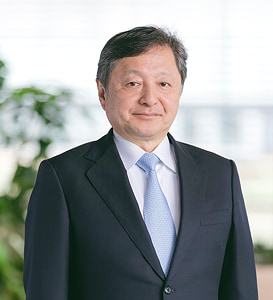
Representative Director, Executive Vice President, CTO,
General Manager of the Technology General Division
Technology Development Driving Business Activities
For AGC, technology development is the driving force behind our business activities. This is grounded in the founding spirit of “contributing to society through materials and solutions,” established when we pioneered the domestic production of flat glass. Since its founding, AGC has consistently pursued the development and advancement of new technologies, and whenever society or industry has changed, we have been quick to provide optimal solutions to meet customersʼ needs. AGC has a corporate culture of embracing new technologies in response to changes in the world and continually challenging itself to create new value. Our strengths lie in the accumulation of technologies cultivated and refined over time, a strong talent pool with advanced skills and know-how and the organizational capability to fully utilize their talents, as well as strong ties with valued customers and industries built on mutual trust. Our ability to drive innovation through organizational capability has also been highly regarded externally. In February 2026, we received the “Systematic Award” at the inaugural Systematic Innovation Management Awards, organized by the Executive Innovation Committee. This award recognizes companies that conduct innovation activities within a systematic framework, and AGCʼs system for generating innovation in an organizational and continuous manner, rather than relying on individuals, was highly praised. It means that AGCʼs strength lies not in one-off technological developments, but in a company-wide framework that continuously generates new technologies and new businesses.
AGCʼs System for Generating Innovation in an Organizational and Continuous Manner
To achieve the goals of the AGC plus-2026 medium-term management plan, the Technology General Division is advancing the following measures.
The first measure is to choose promising themes. A critical factor in technology development is the selection of a theme with strong potential to contribute to the business. One of the initiatives supporting this is the Business and Technology Outlook (BTOL) activities. Before we started this activity, we used to review macro trends in technology and the market each time we formulated a medium- to long-term plan. However, technology, customers, and the market environment change on a daily basis. In the BTOL activity, macro trends in society, industry, and technology are analyzed from a medium- to long-term perspective. AGC then determines the technological areas and development themes that should be prioritized, and reflects the future direction of technological development in a roadmap. This is then reviewed annually in light of changes in technology and market conditions.
In this BTOL activity, we have identified seven priority technical areas. While working with customers to determine the direction of development, we ensure strategic alignment across divisions and prioritize key development themes. As a result, AGCʼs technologies can be applied in a focused and agile manner to promising themes. In this way, to utilize company-wide R&D investment more efficiently, we are always thinking about “what to stop, what to start, and what to continue and strengthen” in technology development. Within the limits of our development resources, we restructure our portfolio by selecting or deselecting themes. In advancing these themes, the Technology General Division and business divisions coordinate their strategies to improve development efficiency and manage themes using Discovery-Driven Planning (DDP). Scenario review meetings are held for each theme, evaluating market, technology, sustainability, and other factors from multiple perspectives from the theme selection stage onward. Technology and business hypotheses are also verified in line with development progress, and themes are revised, discontinued, or strengthened accordingly. Through this type of theme management, the direction of research is clarified and themes are further refined.
The second measure is “ambidextrous development.” Ambidextrous development is the concept of balancing right-handed development to strengthen existing businesses with left-handed development to create new businesses. In right-handed development, we utilize co-creation activities with customers and open innovation with academia to move forward efficiently. Left-handed development is driven primarily by corporate projects (in the Business Development Division, etc.). In these projects, incubation is pursued from the start through collaboration with the business divisions and the Intellectual Property Division. We have established a pipeline ensuring a smooth handoff from development to the Business Development Division and then to the business divisions. About five projects are underway here at any given time. Incubation within the Business Development Division and the transfer to in-house companies have already begun to gain momentum, with the themes of all-solid-state lithium-ion electrolytes and fine ceramics being developed for commercialization. Furthermore, we have plans in 2026 to establish mechanisms for proposing and encouraging innovative and challenging themes.
The third measure is to increase the diversity of our human resources. We have positioned the Yokohama Technical Center (YTC) as a global research hub, and are promoting personnel exchanges with AGC Technovation Center at AGC Europe, and the recruitment of overseas talent. In addition, regular personnel exchanges involving dozens of employees take place between in-house companies and the Technology General Division, to avoid the stagnation of human resources.
The fourth measure is value creation and securing a competitive advantage through DX. In January 2026, the Digital & Innovation Promotion Division and the Information Systems Division were merged to form the Digital & Innovation Management Division reporting directly to the CEO. In the Technology General Division, we have established the RX Promotion Office within the Innovative Technology Laboratories. This office collaborates with the Digital & Innovation Management Division, which drives group-wide DX, to advance RX (Research Transformation), the ransformation of R&D utilizing DX. We develop data analysis tools for materials informatics, which greatly improves the efficiency of materials development by using computational science and informatics. There are numerous examples of these tools being used to speed up materials development and improve processes.
Practicing Technology Exploration and New Business Development Through Open Innovation
Opened in 2021, YTC is our central hub for technology development and our base for open innovation. Every year, it welcomes approximately 500 organizations from Japan and overseas, two-thirds of whom are company representatives with potential future business ties or academic researchers engaged in new technology development through open innovation. In this way, we avoid the self-reliance that researchers tend to fall prey to, and vigorously explore innovative technologies and the creation of new products and businesses through partnerships and collaborations with external parties.
As specific examples of open innovation, we are working to create new technological fields through large-scale collaborations with the University of Tokyo, Nagoya University, Institute of Science Tokyo, and others, representing an advanced form of industry-academia collaboration. We also focus on exploring and cultivating new technologies and markets through collaboration with venture capital firms such as Japan Material Technologies, UMI, and ATAC, as well as with startups connected through those firms.
These open innovation efforts have already led to concrete results. These include: the launch of a figured glass pilot line by AGC Glass Europe, a wholly owned subsidiary of AGC, and Saint-Gobain, that significantly reduces CO₂ emissions, and is supported by the EU Innovation Fund; the development of ultra-high-speed laser processing technology for glass in collaboration with the Graduate School of Engineering at the University of Tokyo; and participation in the “Development of Mass Production Technology and Field Demonstration of Glass Perovskite Solar Cells” project, selected under the NEDO (New Energy and Industrial Technology Development Organization) “Green Innovation Fund Project / Next Generation Solar Cell Demonstration Project.” In addition, we are promoting open innovation in the logistics field. The joint transport initiative led by the Transportation Digital Business Conference (TDBC), a general incorporated association in which we serve as subcommittee leader, and traevo Inc., received the Ministerʼs Award at the 8th Japan Open Innovation Prize (JOIP) from Japanʼs Ministry of Land, Infrastructure, Transport and Tourism (MLIT). Through logistics DX driven by cross-industry co-creation, we are working to enhance overall supply chain efficiency and sophistication, including streamlining transportation and reducing CO₂ emissions.
In parallel with these efforts, we are also promoting internal open innovation. By remodeling and reorganizing YTCʼs research building and consolidating each in-house companyʼs business division laboratory into YTC, we are eliminating the adverse effects of a vertically structured organization, and combining our expertise and strengths across a wide range of fields. This has led to the creation of new business areas and differentiation from competitors. In addition to YTC, we have established open innovation hubs in Cupertino (Silicon Valley), Frankfurt, Singapore, and Shanghai to explore new business opportunities, and are promoting our Globe Activity (Global Activity for Creating New Businesses & Entrepreneurs) to advance open innovation worldwide.
Shifting from “Defensive IP” to "Strategic IP"
The intellectual property that AGC has accumulated to date has mainly served a “defensive IP” role, protecting specific products and businesses from imitation and infringement. Going forward, we will shift to "strategic IP", broadly applying and monetizing the value of our accumulated intellectual property without limiting ourselves to current products and businesses. Rather than defaulting to “defensive IP” as before, we need a strategy that actively utilizes intellectual property on a global scale to realize "strategic IP." Concrete initiatives include the creation of high-impact patent portfolios targeting other companies, and the formation of standardization rules, all with an awareness of the value chain and market. We also use IP analytics to contribute to new and existing business strategies.
Regarding efforts to develop patent portfolios with high impact on other companies, we have accelerated the creation of business-contributing patents by introducing an “award system for inventors” that evaluates inventions based on their level of impact on other companies.
AGC is also actively promoting standardization to contribute to rule-making in global markets. In addition, we are developing activities aimed at creating new markets. To this end, we are strengthening cooperation with and dispatching personnel to Europe-based organizations such as JBCE (Japanese Business Council in Europe) to help formulate rules for Japan, China, and Europe.
Furthermore, by utilizing IP data analysis to identify new business opportunities in diverse fields and uncover potential new value in existing businesses, we contribute to both new business development and current business strategy.
By leveraging these initiatives and fully utilizing our intellectual property, we will achieve sustainable enhancement of corporate value.
Cultivating the Next Generation of Talent Through Diverse Career Paths
Under the slogan “AGC People: Driving our Growth!” we believe that the development and utilization of technical human resources, who account for approximately 80% of our new graduate hires, is key to further enhancing corporate value. Around 30% of employees in the Technology General Division at our corporate headquarters hold a doctoral degree*. In addition, each year we send several employees to top-tier universities overseas, providing opportunities for them to pursue degrees and conduct cutting-edge research. In this way, by participating in world-leading research networks, we are gathering information and building global relationships. We have also established a special researcher (fellow) system within our HR framework, and introduced a technical talent system for developing world-leading experts in specific technical fields.*Including those expected to obtain a doctoral degree
For the creation of new businesses, we dispatch personnel to overseas Globe Activity bases, providing them with opportunities to explore global business opportunities and build international networks. We also send personnel to venture capital firms to gain valuable practical experience such as serving as independent directors of investee companies, while sharpening their business acumen in a dynamic environment where new technologies and businesses are created. Through the provision of such diverse career paths, I believe the mission of the division under the CTOʼs responsibility is to continuously develop the next generation of talent to lead AGC.
However, it is also a fact that some individuals overestimate potential risks and avoid taking on difficult challenges. In addition, there is no small number of researchers who remain within their own areas of expertise and are unwilling to actively engage with other fields or departments. To break away from this status quo and enable all personnel to maximize their potential, it is essential to foster a culture that encourages and recognizes challenge, to revitalize personal interaction including participation in global networks, and to strengthen dialogue with management. Going forward, we intend to place even greater emphasis on creating structures and mechanisms for this purpose.
Steadily Laying the Groundwork for Corporate Value Enhancement
The Technology General Division is the engine driving AGCʼs growth and innovation. It continuously creates new technologies and products that exceed customer expectations, and achieves overwhelming cost competitiveness through innovative production technology. It also seeds and incubates large-scale business themes with an eye to the future. While none of these tasks are easy, they are goals that AGC, with its talented and diverse workforce, must pursue.
Under a corporate culture of pushing limits and striving to evolve, we find joy and purpose in our work as we provide indispensable materials and solutions to the world.
At AGC, we are steadily laying the groundwork to enhance corporate value in all fields of business. Just as our display and automotive businesses have returned to a growth trajectory, we expect similar results to emerge across other business domains, strategic businesses, and new business areas. We hope you look forward to our future progress.