March 26, 2026Products
AGC’s “Transparent 5G Glass Antenna” Adopted for the Premium-Class Seat Dedicated Wi‑Fi Service on the Tokaido Shinkansen N700S
— The World’s First Transparent 5G Glass Antenna Adoption for a Railway Vehicle —
AGC (AGC Inc., Headquarters: Tokyo; President: Yoshinori Hirai) has developed a “Transparent 5G Glass Antenna” (hereinafter “5G Glass Antenna”) that has been adopted by Central Japan Railway Company (President & CEO: Shunsuke Niwa; hereinafter “JR Central”) for premium‑class seats installed in selected N700S trainsets on the Tokaido Shinkansen. By integrating antenna functionality directly into the train windows, this product stabilizes radio signal transmission and reception even at high speeds, thereby enhancing Wi‑Fi quality for premium‑class passengers. Its ultra‑fine mesh structure makes the antenna lines unobtrusive, ensuring that visibility is not impaired and scenic views from the train windows remain unaffected. Commercial operation of the train equipped with these premium‑class seats is scheduled to begin in October 2026. This will mark the world’s first* commercial operation of a railway vehicle equipped with a 5G glass antenna.
|
|
|
|
Image of the Premium-Class Seat (Private Compartment Type)on the Tokaido Shinkansen N700S |
5G Glass Antenna |

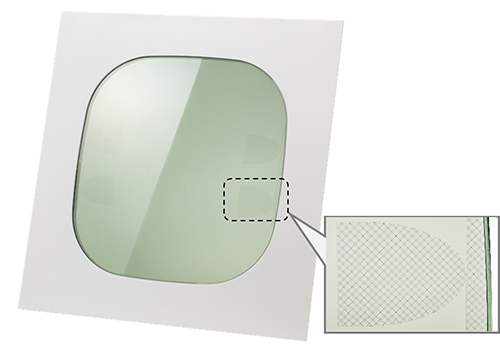
In recent years, as diverse use cases have expanded—such as conducting online meetings while traveling—there has been a growing demand for further improvements in the comfort and reliability of onboard Wi‑Fi environments. In conventional onboard Wi‑Fi services, communication is conducted between trackside base stations and 4G antennas installed inside the train, with signals passing through openings in the train body such as windows. As a result, radio signals tend to weaken when passing through the windows or body panels, and depending on location or conditions, communication may become unstable, making it difficult to maintain a comfortable level of connectivity.
The 5G glass antenna adopted for the premium‑class seats has been specially designed by AGC for Shinkansen windows to improve communication quality. By integrating 5G antenna functionality directly into the window itself, the antenna reduces signal loss when radio waves pass through the train body, thereby improving and stabilizing communication quality between trackside base stations and the onboard Wi‑Fi routers. In addition to meeting the required safety and durability standards for Shinkansen window glass, the antenna uses an ultra‑fine mesh conductive pattern for its antenna elements, minimizing visual recognition of the antenna and preserving passengers’ scenic views from the windows.
The AGC Group will continue to create new value through the provision of unique materials and solutions—including the 5G glass antenna—and contribute to the realization of a safe and comfortable mobility society.
[Notes]
|
* |
Based on AGC’s research (as of the end of February 2026) |
For Reference
• Explanation Video
<Reference Information>
About the AGC Group
AGC Inc.(Headquarters: Tokyo, President & CEO: Yoshinori Hirai) is the parent company of the AGC Group, a world-leading glass solution provider and supplier of flat, automotive and display glass, chemicals, ceramics and other high-tech materials and components. Based on more than a century of technical innovation, the AGC Group has developed a wide range of cutting-edge products. The AGC Group employs some 56,000 people worldwide and generates annual sales of approximately 1.7 trillion Japanese yen through business in about 30 countries. For more information, please visit www.agc.com/en
<Benefits of the 5G Glass Antenna>
Communication conditions with trackside base stations

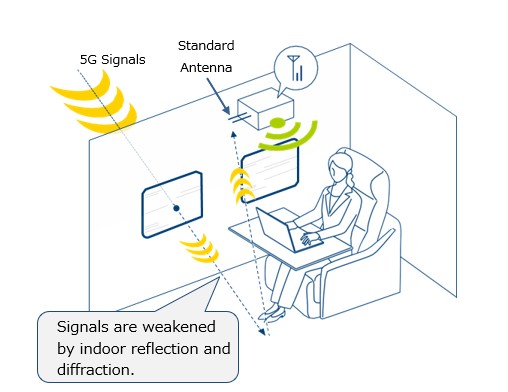 |
Standard Antenna ■The signals from the trackside base stations enter the metal train body through the windows and reach the Wi-Fi router after repeatedly reflecting and diffracting inside the cabin, causing the signal to weaken in the process. This type of communication condition is called Non-Line-of-Sight (NLOS). ■Standard antennas are simple and easy to use, but their antenna performance has not been optimized for installation on railway vehicles. |
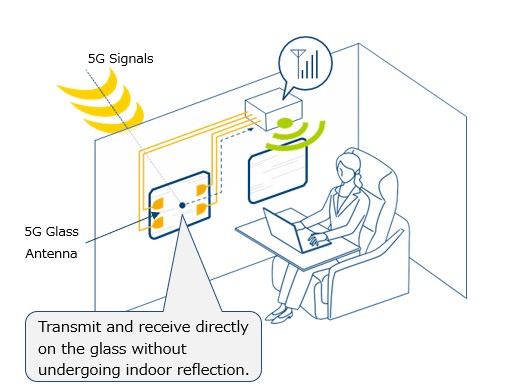 |
5G Glass Antenna ■With the antenna installed above the window, radio waves from the trackside base stations can reach the Wi-Fi router without undergoing indoor reflection or diffraction. This communication condition is called Line‑of‑Sight (LOS). ■In general, LOS communication is said to provide a higher average throughput compared to NLOS. ■The 5G glass antenna is specially designed for installation on Shinkansen windows, making it easier to ensure antenna performance compared to standard antennas. |
- Media inquiries
- AGC Inc.
Corporate Communications & Investor Relations Division