April 3, 2026Environment & CSR
Japan’s First “Window-to-Window” Glass Recycling Within a Single Building
— Closed-Loop Recycling of Waste Flat Glass Generated during a Large-Scale Renovation —
Taisei Corporation (President and Chief Executive Officer, Representative Director: Yoshiro AIKAWA; hereinafter “Taisei”) and AGC Inc. (President: Yoshinori Hirai; hereinafter “AGC”) announced the successful demonstration of Japan’s first*1 horizontal recycling of window glass within the same building at the large-scale renovation of the Nippon Life Higashi-Yaesu Building (Chuo-ku, Tokyo). The two companies collected and recycled waste flat glass generated during the renovation. The recycled material was used as part of the raw materials to manufacture new window glass, which was then reinstalled in the same building.
By promoting resource circulation using manufacturing sites in Japan, Taisei and AGC aim to build a stable supply system of glass that meets the quality required for architectural applications. The initiative is also expected to contribute to reducing resource and energy use, lowering CO2 emissions, and reducing waste.
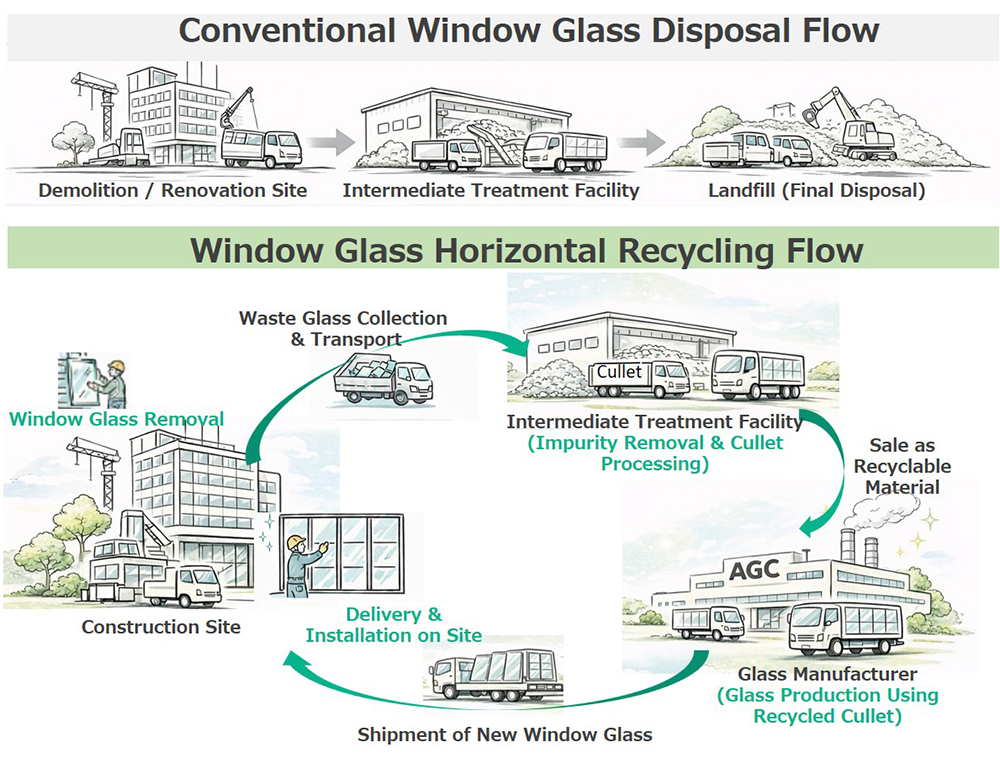
Establishing and implementing a “window-to-window” circulation scheme
In this initiative, Taisei and AGC demonstrated a scheme that circulates glass within the same building, starting from renovation works.
Reducing waste generated from building renovation and demolition and advancing resource circulation are key issues for the construction industry. Large-scale renovation and demolition projects generate a certain volume of waste glass; however, much of it is currently landfilled. Therefore, it is increasingly important to establish and implement a circulation scheme for glass resources originating from renovation and demolition projects.
On the other hand, horizontal recycling of window glass requires safe removal from buildings and the appropriate removal of contaminants such as sealing materials and films, in order to secure the quality of cullet (recycled glass scraps) usable as raw material for architectural flat glass. These requirements have made horizontal recycling of window glass challenging.
Given this context, Taisei and AGC began a demonstration in August 2023 to recycle waste flat glass and have worked to build and implement a horizontal recycling system.
Overview of the initiative and results
In the renovation project, approximately 5.7 tons of window glass installed on the north and east façades of floors 4 through 9 of the building (SRC structure; five basement floors and nine above-ground floors) were collected. Based on a contaminant treatment method verified by Taisei, an industrial waste processing contractor removed contaminants and conducted crushing, refining cullet that meets the quality requirements for architectural flat glass. AGC then manufactured new wired glass using this cullet as part of the raw materials. The newly manufactured wired glass was reinstalled as window glass (approximately 80 m²) on the south façade of floors 5 through 6 of the same building at the end of March 2026.
As a result, the companies achieved horizontal recycling of approximately 5.7 tons of window glass, with an estimated CO2 reduction effect of approximately 3.4 tons*2. In addition, the initiative contributed to saving approximately 6.8 tons of virgin raw materials. Since cullet can be melted at a lower temperature than virgin raw materials, additional CO2 reduction effects are also expected through reduced energy use in the manufacturing process.
Taisei and AGC will accelerate the social implementation of horizontal recycling of architectural flat glass to help realize a carbon-neutral and resource-circulating society. By promoting standardization of horizontal recycling of architectural flat glass, including the advancement of contaminant removal technologies and optimization of intermediate processing, the companies will contribute to establishing a sustainable construction industry.
Comment from Taisei Corporation
Taisei is working to build and standardize a circulation model in which waste flat glass generated at construction sites is utilized again as architectural flat glass. This initiative contributes to reducing resource and energy use, lowering CO2 emissions, and reducing waste, and it presents a new approach to resource circulation in the construction industry.
While this initiative is a demonstration and implementation model starting from renovation works, Taisei aims to establish a system that enables the collection and recycling of waste flat glass generated from construction sites using the same scheme in the future. Through this initiative, Taisei will transform waste flat glass from “waste” into “resources” and promote the social implementation of a sustainable resource circulation model in the construction industry.
Comment from AGC
In its medium-term management plan, AGC plus-2026 , the AGC Group has defined “three social values” to be created through its products and technologies. In the “Blue planet” value, AGC is working to reduce environmental impact across the entire value chain.
This initiative indicates that horizontal recycling of window glass can be an effective option not only for reducing environmental impact but also for mitigating resource procurement risks, given that part of glass raw materials depends on overseas supply. In addition, this initiative presents a limited, demonstration-based model in which demolition/renovation glass is recycled and used as architectural glass within the same building to concretely illustrate the potential of resource circulation. Going forward, without limiting use to the same building, AGC will promote the collection and recycling of demolition/renovation glass and contribute to the social implementation of resource circulation by expanding use across a wide range of architectural fields—including building renovation and new construction—centered on a circulation system supported by manufacturing sites in Japan.
〈Notes〉
|
*1 |
According to research by AGC. |
|
*2 |
By using cullet as recycled material, CO2 derived from raw materials as well as energy-origin CO2 from procurement and manufacturing can be reduced. A GHG emission reduction of approximately 0.6 tons per 1 ton of glass (Scope 1+2+3) is expected from raw material procurement through manufacturing. |
<Media inquiries>
Taisei Corporation, Corporate Communications Department, Public Relations Office
AGC Inc., Corporate Communications & Investor Relations Division: Inquiries from the Press