August 19, 2026ProductsEnvironment & CSR
Japan’s First Recycle Waste Window Glass from Demolition Sites as part of the Raw Materials for Float Glass Production
-AGC and Obayashi establish a closed-loop recycling process using waste window glass
from the MUFG Bank`s Head Office demolition project-
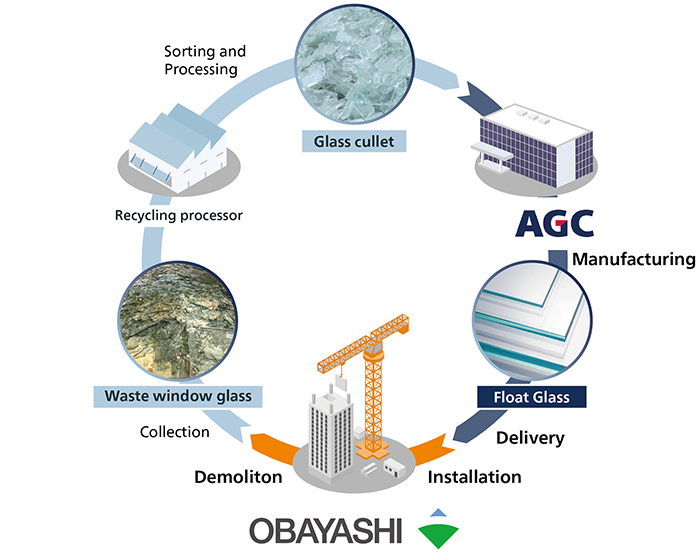
AGC Inc., Obayashi Corporation and MUFG Bank today announced an initiative to recycle waste window glass generated during building demolition as part of the raw materials used in the production of architectural float glass. Obayashi and AGC have established a closed-loop recycling process*1 that uses waste window glass generated at demolition projects undertaken by Obayashi as part of the raw materials for architectural float glass production. The glass produced through this process is expected to be used in building applications, including projects undertaken by Obayashi.
Closed-Loop Recycling Process for Converting Waste Window Glass into Float Glass Raw Material
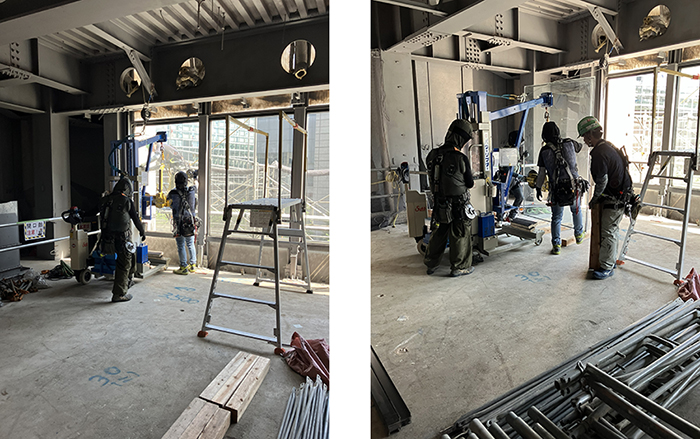
Waste Window Glass Collection Process at the MUFG Bank’s Head Office Demolition Project
1. Background
The construction industry is advancing initiatives to reduce whole-life carbon emissions*4 from buildings as part of efforts to achieve carbon neutrality by 2050. Whole-life carbon refers to CO₂ emissions generated throughout a building's life cycle. This includes the manufacture and transportation of construction materials, construction, operation, demolition and disposal.
Upfront carbon*5 is generated during the production stage of construction materials and during the construction stage. The production stage includes raw material procurement, transportation and manufacturing. The construction stage includes transportation to the site and construction work. Because construction companies have significant potential to reduce these emissions, the active use of reused and recycled construction materials is an important way to promote circular resource use.
Focusing on steel materials, which are associated with significant CO₂ emissions during production, Obayashi has been promoting circular use of a wide range of construction materials. In June 2024, Obayashi launched Japan's first initiative to reuse structural steel members recovered from demolished buildings in newly constructed buildings. In November 2024, Obayashi established a closed-loop recycling process for steel scrap. In December 2025, Obayashi established a closed-loop recycling process for aluminum scrap. Obayashi has also been studying design methods for reuse, developing related technologies, and establishing optimized transportation processes for recycling.
AGC has been working with local governments and private-sector companies to build an integrated system for collecting, processing and supplying waste window glass generated at demolition sites. This system covers collection, intermediate processing and the supply of cullet as a recycled raw material. AGC is focusing on ensuring cullet quality and establishing a stable supply system. AGC is also accumulating operational know-how in collaboration with relevant stakeholders and aims to further expand the circular use of architectural glass.
MUFG Bank began demolition work on its Head Office building in February 2025. The bank started new construction in April 2026, toward the planned completion of the new MUFG Headquarters building in October 2030. The new MUFG Headquarters redevelopment has been planned to contribute to a sustainable society and help reduce environmental impacts.
In the construction process as well, MUFG Bank is working with relevant stakeholders on initiatives that help reduce environmental impacts. These efforts are based on Mitsubishi UFJ Financial Group's purpose: "Committed to empowering a brighter future." MUFG Bank supported the initiative by Obayashi and AGC and decided to provide waste window glass generated from the demolition of the MUFG Bank`s Head Office building.
2. Initiative at the MUFG Bank’s Head Office Demolition Project and Effects of Applying the Closed-Loop Recycling Process
At the MUFG Bank`s Head Office demolition project in Chiyoda-ku, Tokyo, this process is being applied for the first time. Waste window glass generated from the demolition work is collected and processed into cullet through an intermediate treatment process. The cullet is then transported to AGC's Kashima Plant in Kamisu, Ibaraki Prefecture.
At the Kashima Plant, the cullet is used as part of the raw materials for manufacturing clear float glass through the float process, which requires high raw-material quality. The resulting architectural flat glass is used for building applications. As part of this use, the glass is planned for use at construction sites handled by Obayashi.
In conventional glass recycling, waste glass has been recycled into products such as patterned glass and wired glass. By applying this process, waste window glass can be used as part of the raw materials for transparent float glass. This is expected to make it possible to expand recycling applications across architectural flat glass products.
The process is expected to help expand and advance glass recycling. It is also expected to contribute to the development of a supply chain that promotes circular resource use and helps reduce environmental impacts associated with manufacturing and transportation.
Effects of Applying This Process at the MUFG Bank`s Head Office Demolition Project
Floor area: approximately 120,000 m²
|
Item |
Amount |
|
Amount of recycled waste window glass, including the portion recycled into glass wool |
149 metric tons |
|
Amount of waste window glass recycled into flat glass through the closed-loop recycling process |
81 metric tons |
|
CO₂ emissions reduction through the closed-loop recycling process*6 |
49 metric tons |
3. Future Outlook
The Obayashi Group has formulated its long-term vision, Obayashi Sustainability Vision 2050. Under this vision, the group is promoting a wide range of environmental initiatives to realize the sustainability of the planet, society, people and Obayashi itself.
In promoting the circular use of construction materials, Obayashi aims to establish processes for recycling, reuse and effective resource utilization. Obayashi intends to do so by strengthening collaboration with relevant business operators and accumulating management know-how. Through these efforts, Obayashi seeks to contribute to a circular economy and to efforts toward a decarbonized society.
In its medium-term management plan, AGC plus-2026 , the AGC Group sets out three social values provided by the group. Under "Blue planet," one of these values, AGC regards the efficient use of resources as an important opportunity. AGC seeks to contribute to a more sustainable global environment through the expansion of closed-loop recycling of glass.
Mitsubishi UFJ Financial Group announced its Carbon Neutrality Declaration in May 2021. The group aims to achieve net-zero greenhouse gas emissions from its own operations by 2030. It also aims to achieve net-zero greenhouse gas emissions from its financed emissions portfolio by 2050.
Through the MUFG Bank‘s Head Office demolition project, Obayashi, AGC and MUFG Bank seek to contribute to more advanced resource circulation and to efforts toward a decarbonized society. Obayashi and AGC intend to continue operating the process established through this initiative. By expanding the scope of this process, Obayashi and AGC seek to further promote the circular use of construction materials.
Notes
|
*1 |
Closed-loop recycling in the construction industry |
|
*2 |
First in Japan |
|
*3 |
Float process |
|
*4 |
Whole-life carbon |
|
*5 |
Upfront carbon |
|
*6 |
CO₂ emissions reduction amount |
Contact
Obayashi Corporation
Corporate Communications Department
Email: press@ml.obayashi.co.jp
AGC Inc.
Corporate Communications & Investor Relations Division
Contact form: AGC corporate website