

Adopted on the Tokaido Shinkansen
AGC’s Transparent 5G Glass Antenna
How Train Windows
Are Advancing
Onboard Connectivity
A glass antenna designed for rolling stock that helps enhance onboard Wi-Fi connectivity and contributes to an improved passenger experience.

Growing Demand for Reliable Connectivity
As access to information and digital services on the move becomes an integral part of daily life, demand for stable and reliable connectivity continues to grow.
Onboard, passengers rely on seamless connectivity to host video calls, access cloud applications, browse the web, make reservations, and process digital payments. Any interruption in connectivity can negatively affect these services and the overall travel experience.
As a result, onboard Wi-Fi is now expected to deliver more than basic connectivity. Railway operators are increasingly seeking communication quality that enables passengers to stay connected comfortably, even while traveling at high speeds.

A New Approach to Improving Connectivity
AGC's Transparent 5G Glass Antenna
Rethinking How Signals Are Received
To improve onboard Wi-Fi connectivity, railway operators may consider upgrading communication equipment, such as replacing 4G-compatible devices and Wi-Fi routers with 5G-capable alternatives. However, even with more advanced equipment, a key challenge remains: how efficiently radio signals can be transmitted to and received from trackside base stations.
AGC's Transparent 5G Glass Antenna is a glass antenna for rolling stock that integrates a transparent antenna directly into the train window.
Its unique feature lies in using the window itself as a location for receiving radio signals, creating a new option for enhancing onboard connectivity.

1. Train Windows Are Well-Suited for Sending and Receiving Signals
Train bodies are predominantly made of metal, which blocks 4G and 5G cellular signals from trackside base stations. Consequently, train windows serve as the primary gateway for radio waves entering and leaving the vehicle.
With conventional onboard Wi-Fi systems, signals entering through the windows must travel through the passenger cabin before reaching the Wi-Fi router. Along the way, they may be reflected, scattered, or diffracted by interior structures such as walls, floors, and equipment (Note 1). This can weaken the signals and increase the likelihood of communication interruptions.
AGC's Transparent 5G Glass Antenna takes a different approach. The transparent antenna integrated into the window communicates directly with trackside base stations. The received signals are then delivered directly to the onboard Wi-Fi router through a wired connection. As a result, the signals are less affected by reflections and diffraction inside the cabin (Note 2), helping to reduce signal loss.This can contribute to more stable connectivity.
Note 1: Known as Non-Line-of-Sight (NLOS) communication.
Note 2: Known as Line-of-Sight (LOS) communication. Generally, LOS offers higher average throughput than NLOS.
Conventional
Signals can weaken as they are reflected and diffracted inside the cabin.*Hover over the image to start the animation.
5G Glass Antenna
Signals received by the window antenna are delivered directly to the Wi-Fi router, helping maintain signal strength.*Hover over the image to start the animation.
2. Train Windows Make It Easier to Distribute Multiple Antennas
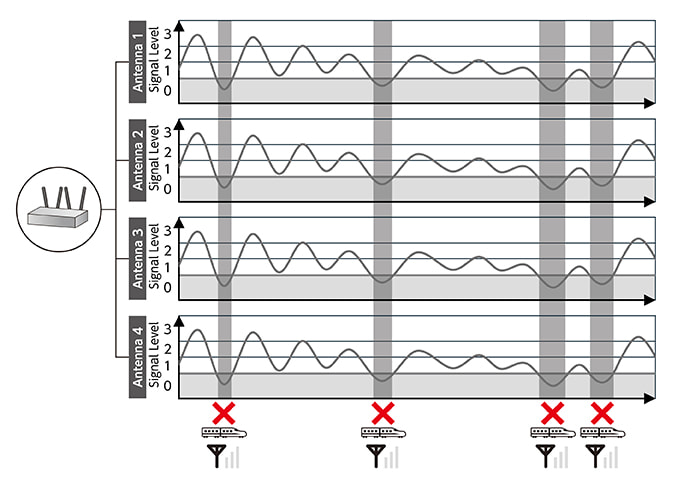
Another advantage of train windows is that they provide a suitable location for deploying multiple antennas. Because windows offer a relatively large installation area, AGC's Transparent 5G Glass Antenna allows multiple antennas to be positioned with sufficient spacing between them.
By transmitting and receiving signals through these distributed antennas, the system can better maintain connectivity even when signal conditions deteriorate at one antenna location. Other antennas can help compensate, improving overall communication reliability.
Signal Strength During Train Operation
Signal strength varies continuously as a train moves.*Hover over the image to start the animation.
Conventional
When antennas are clustered together, they receive similar signals, increasing the risk of connectivity degradation.
5G Glass Antenna
When antennas are distributed, they can receive different signals, helping maintain stable connectivity.
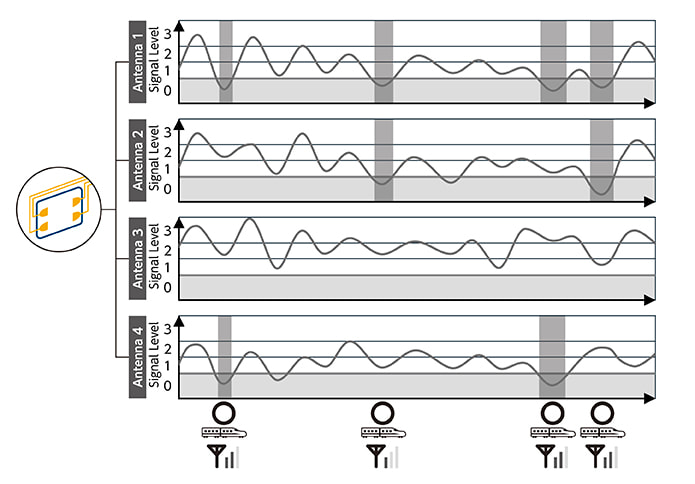
These features help support a more stable connectivity environment, even when trains are operating at high speeds.
As a result, railway operators can help provide a more comfortable onboard Wi-Fi experience for passengers, contributing to enhanced passenger services and satisfaction.
Benefits Beyond Connectivity: Advantages for Train Design
The advantages of AGC's Transparent 5G Glass Antenna extend beyond improving onboard connectivity. By utilizing train windows as antenna locations, the solution can also offer benefits from both vehicle design and operational perspectives.
Preserving Visibility and a Sense of Openness
The antenna uses a fine mesh structure that is designed to be unobtrusive. This helps minimize its visual impact, allowing operators to maintain the sense of openness and exterior views that passengers expect from train windows.
Eliminating External Vehicle Aerodynamic Drag
One approach to improving onboard connectivity is to install antennas on the exterior of the train, such as on the roof. However, externally mounted antennas can become additional protrusions, potentially increasing the risk of damage and affecting aerodynamics or wind noise.
Because AGC's Transparent 5G Glass Antenna is integrated into the window, there is no need to add new external protrusions to the vehicle.
Suitable for Both New and Existing Rolling Stock
The solution can also be introduced to existing vehicles by replacing window glass. Because it does not require major modifications to the car body structure, the impact on waterproofing design and maintenance can be minimized, helping reduce integration complexity.
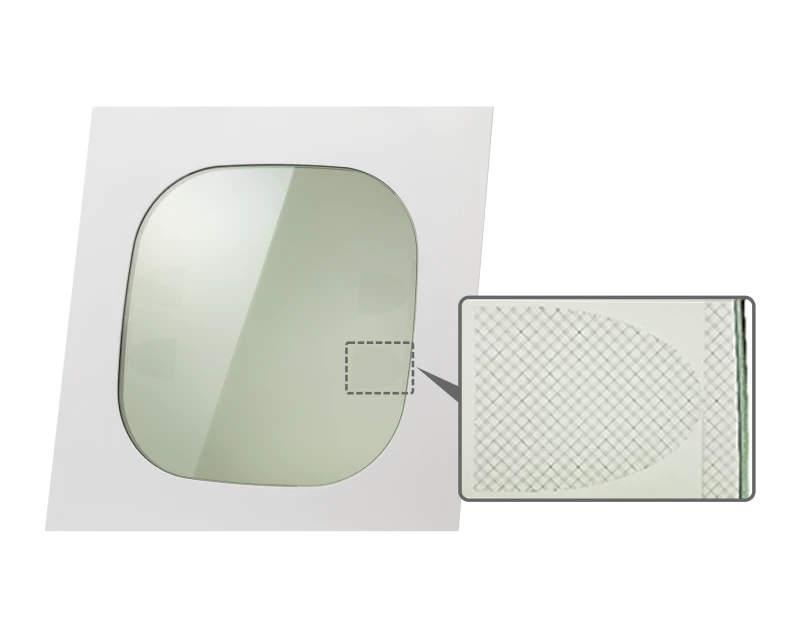
In addition, deployment does not need to be carried out across an entire fleet at once. Operators may choose to introduce the solution gradually, starting with vehicles where connectivity is a higher priority, such as premium-service cars.
Implementation Considerations:
Implementation requirements vary depending on vehicle specifications and operating conditions.
The glass antenna is one component of the overall onboard communications system. Evaluation of the complete system, including 5G-compatible Wi-Fi routers and cabling between the glass antenna and onboard equipment, is required when considering deployment. Please contact us to discuss feasibility, implementation options, and vehicle-specific requirements.
Technical Support for Implementation
Leveraging AGC's expertise in automotive and railway glazing design and manufacturing, together with nearly 50 years of glass antenna development experience, we support customers throughout the implementation process, from initial evaluation to deployment of the Transparent 5G Glass Antenna.
Initial Assessment and Requirements Definition
We help evaluate the feasibility of implementation based on vehicle-specific conditions, including car body structures, window specifications, and onboard communication systems.
In addition, we provide recommendations on antenna placement and system architecture tailored to the requirements of each vehicle platform.
Validation Testing and Performance Evaluation
We support the planning and execution of validation testing by helping define appropriate evaluation methods and test conditions for connectivity performance.
Our antenna development teams in Europe, North America, and Asia work closely together to support validation activities, international projects, and global deployment programs.
Design and Integration Support
We provide technical support for antenna configuration design based on vehicle structures and window specifications, as well as integration with onboard communication equipment.
Our support also includes design verification using engineering data such as 3D CAD models. From implementation design and specification coordination to certification support, AGC provides comprehensive assistance throughout the project lifecycle.
Case StudyTokaido Shinkansen Supreme Class
AGC's Transparent 5G Glass Antenna has been selected for the windows of the Supreme Class private-compartment cars introduced on selected N700S trains of Japan's Tokaido Shinkansen high-speed rail service.
The solution was adopted as part of efforts to provide an enhanced connectivity environment for passengers, particularly in use cases that demand high-quality communications, such as online meetings while traveling.
The antenna's ability to integrate directly into the window without obstructing exterior views was also recognized as a key advantage.
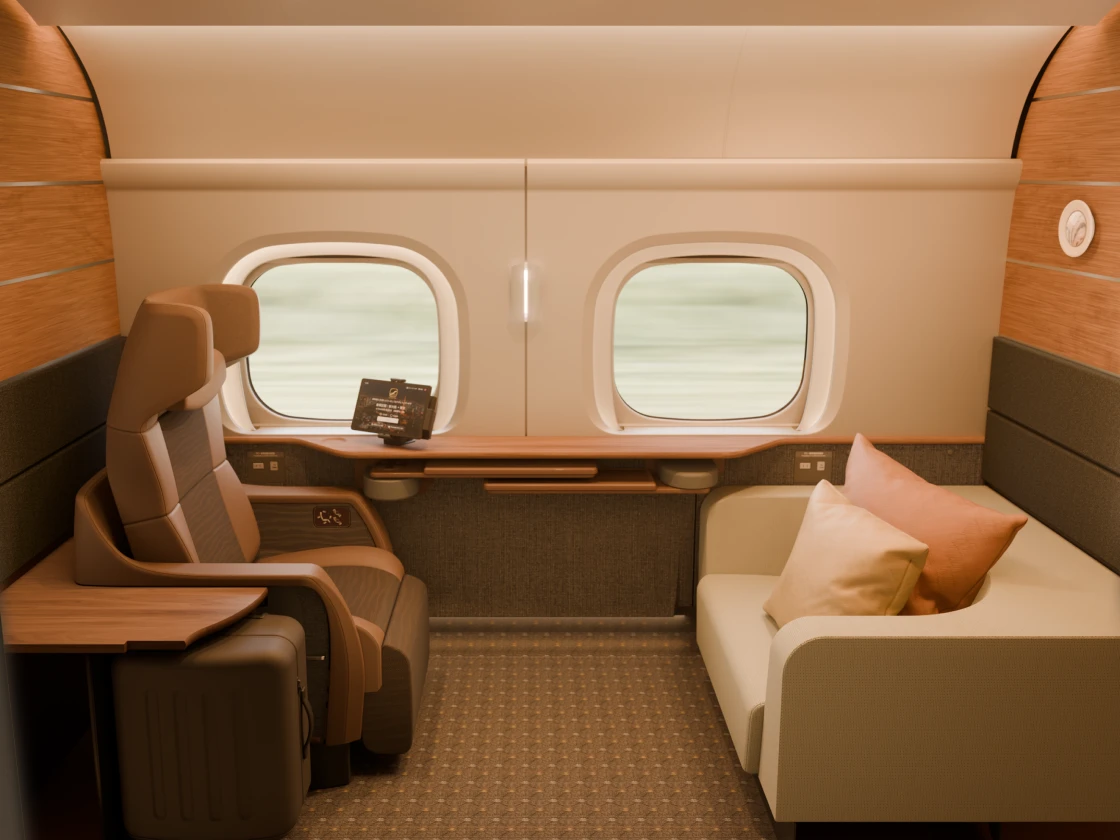
Learn more about the background to the adoption of the solution for the Tokaido Shinkansen Supreme Class and the key evaluation considerations in this interview with Central Japan Railway Company (JR Central) and AGC.
Frequently Asked Questions
- QHow much can signal reception and transmission performance be improved compared with conventional solutions?
- AImprovement levels vary depending on various factors, including the operating environment, vehicle structure, and the configuration of onboard communication equipment.
AGC can support customers with communication simulations and performance evaluations based on their specific operating conditions and requirements. Please contact us to discuss your project and expected use cases. - QAt what operating speeds has the solution been tested?
- AAGC has validated communication performance under the operating conditions of the Tokaido Shinkansen, including its commercial operating speeds.
Actual communication performance depends on factors such as the operating environment, network conditions, onboard equipment configuration, and vehicle design. - QCan connectivity also be improved in tunnel sections?
- ACommunication performance inside tunnels depends on the availability and quality of radio signals provided by trackside communication infrastructure.
Where radio signals from trackside base stations are available, AGC's Transparent 5G Glass Antenna can help utilize those signals more efficiently by receiving them directly through the train windows and delivering them to onboard communication equipment. This can help make more effective use of the available radio signals. - QIs the antenna compatible with technologies other than 5G?
- AYes. The solution is also compatible with LTE and 4G networks. Supported frequency bands and specifications can be tailored to the expected communication environment and project requirements. Please contact us to discuss your specific needs.
- QCan the antenna in an existing onboard Wi-Fi system be replaced with the Transparent 5G Glass Antenna?
- AYes. Integration is possible with existing onboard Wi-Fi systems. As compatibility with the current communication equipment and system architecture must be evaluated, AGC works closely with system integrators and communication equipment providers to determine the most suitable configuration.
- QAt what stage should the solution be considered for a new rolling stock project?
- AWe recommend considering the solution from the early design phase. Early engagement makes it easier to optimize antenna placement and ensure compatibility with vehicle structures, window specifications, and onboard communication systems.
Start by exploring whether the concept is right for your project.
Contact us to discuss feasibility, implementation considerations, and initial requirements for your vehicle application.
AGC Glass Solutions for Rail and Automotive Applications

-
Learn more
WAVETHRU™ Retrofit for Railway Windows
Train windows with thermal insulation coatings can block radio signals, which may lead to unstable onboard connectivity.
WAVETHRU™ Retrofit uses laser processing technology to improve radio signal transmission through insulated glass while maintaining its thermal performance. The solution can deliver up to 25 dB improvement in signal transmission, enabling connectivity performance comparable to that of non-coated windows.
Because the treatment can be applied directly to existing window glass, implementation is possible without major structural modifications and can typically be completed within a short installation period.
WAVETHRU™ Retrofit has been widely adopted by railway operators across Europe.
-
Learn more
Automotive Glass Solutions
AGC provides a broad portfolio of automotive glass solutions to vehicle manufacturers worldwide. Our products include laminated and tempered automotive glass, as well as advanced mobility solutions such as cover glass for in-vehicle displays and glass antennas that support next-generation vehicle connectivity.
Leveraging our global technology development and manufacturing network, we deliver high-quality products, services, and solutions to automotive manufacturers worldwide.