

A New Window on High-Speed Rail Travel How JR Central and AGC Are Bringing 5G Connectivity to Japan’s Shinkansen
- #Mobility
- #Collaboration
Whether working remotely, browsing social media, streaming videos or using AI, people expect reliable internet access wherever they are. That expectation doesn't change when they're traveling aboard a Shinkansen at 285 kilometers per hour. JR Central has unveiled Supreme Class, a new premium seating option above its Green Car service. Among its new features is a 5G glass antenna window developed jointly with AGC. Its built-in transparent antenna helps provide a reliable internet connection, even as the train speeds along. We spoke with the teams at JR Central and AGC about what led to the adoption of the technology and the story behind its development.
Profile

Jun Ito
Manager, Rolling Stock Department, Shinkansen Operations Division, JR Central

Kiyoshi Nobuoka
Director, Mobility Connectivity Business Development, Marketing Office, Automotive Company, AGC Inc.

Naoki Hashimoto
Manager, Functional Solution Group, Technology Development Management Division, Asia General Division, Automotive Company, AGC Inc.
The Tokaido Shinkansen has been a vital part of Japan’s transportation network for more than 60 years. With its high capacity, punctual service and strong safety record, the high-speed rail line has played a key role in supporting the country’s economy and daily life.

Jun Ito
Manager, Rolling Stock Department, Shinkansen Operations Division, JR Central
In October 2026, JR Central will introduce Supreme Class on select N700S trains operating on the Tokaido and Sanyo Shinkansen lines. The new service is designed to offer passengers a more comfortable and convenient way to make the most of their time on long-distance journeys.
“We have long focused on increasing capacity, including running up to 13 Nozomi trains per hour,” said Ito of JR Central, who works to improve the onboard passenger experience. “But as lifestyles and work habits change, so do passengers’ expectations of how they spend their time on board. For a growing number of international visitors, riding the Shinkansen is part of the appeal of traveling in Japan. To meet these changing needs, we began exploring new ways to make the journey itself more enjoyable.”
The Shinkansen travels at speeds of up to 285 kilometers per hour, yet passengers can spend hours on board during long-distance journeys. Making that time more comfortable and convenient, rather than simply getting passengers from one place to another, is essential to maintaining and enhancing the value of Shinkansen travel.
Passengers travel on the Shinkansen for many reasons, from business trips and family visits to vacations. They also vary widely in age, lifestyle and nationality, and what they expect from their time on board differs accordingly. Supreme Class is designed to accommodate these diverse needs, with features such as individually adjustable lighting, climate control and audio volume. But one feature is particularly important to the premium experience it aims to deliver: reliable internet connectivity.
As people increasingly rely on the internet for a wide range of activities, reliable connectivity has become an expectation even while traveling.
On a Shinkansen traveling at high speed, however, maintaining a stable connection with ground-based cellular base stations presents a technical challenge. Providing a reliable, high-quality connection even under these conditions is essential to the premium travel experience Supreme Class aims to deliver.
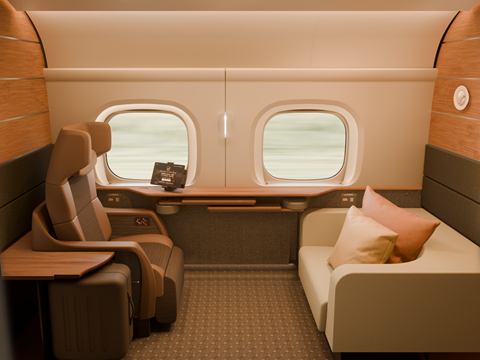
Supreme Class, scheduled to debut on select N700S trains on the Tokaido and Sanyo Shinkansen lines in October 2026
To meet these needs, Supreme Class is the first to feature AGC’s Transparent 5G Glass Antenna (hereafter, 5G glass antenna), which enables the window itself to transmit and receive radio signals. The antenna efficiently captures signals from cellular base stations along the railway line, providing passengers with a reliable internet connection on their laptops and smartphones.
JR Central has long provided onboard internet access through Wi-Fi routers installed on its trains. However, the rod-shaped antennas used to communicate with cellular base stations were located behind the overhead luggage racks, where the train’s body could obstruct radio signals. As the train moved, changes in its distance and position relative to the base stations could further disrupt the connection.
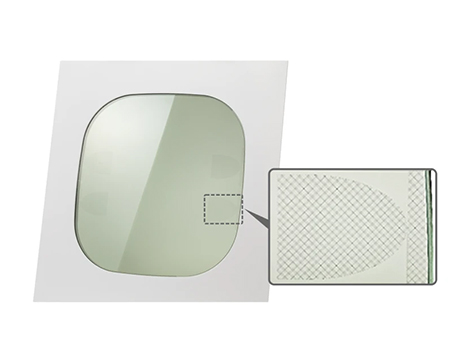
AGC’s 5G glass antenna offered a new solution. By integrating a 5G antenna directly into the window, the technology reduces signal loss between the cellular base stations and the onboard Wi-Fi routers, providing a more stable connection. The antenna uses a fine conductive mesh to improve reception without obstructing passengers’ view from the train.
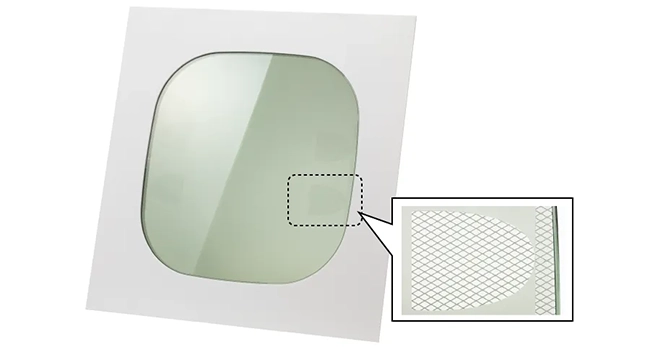
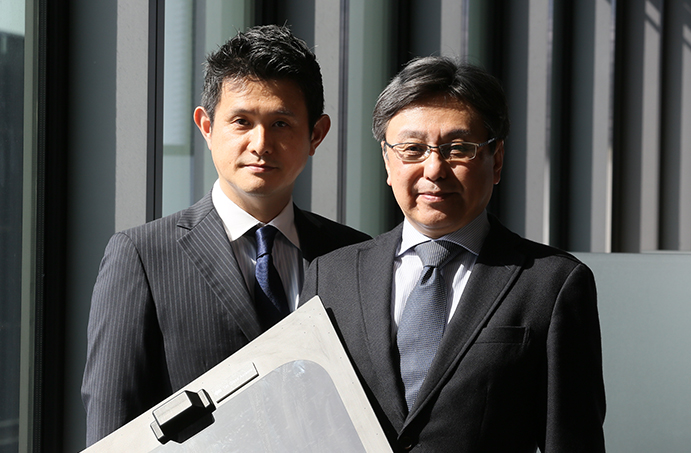
AGC’s 5G glass antenna for Supreme Class, developed in close collaboration with JR Central to enhance connectivity without compromising passengers’ view from the train
The idea of integrating antennas into window glass is not new. AGC began developing and commercializing glass antennas for AM and FM radio reception in automobiles as early as the late 1970s.
At the time, antenna development was largely the domain of specialized antenna manufacturers, making it unusual for a glassmaker to venture into the field. But AGC saw an opportunity: it anticipated a future in which wireless connectivity would become standard in automobiles, giving glass an entirely new role.
Integrating an antenna into a car window involves more than simply making it work. The glass must meet safety requirements without obstructing occupants’ view or compromising the vehicle’s design. And because body structures and window specifications vary from model to model, the antenna must be carefully tailored to each vehicle. Meeting all these requirements is essential to making the technology commercially viable. Since installing a radio-frequency anechoic chamber at its Aichi automotive glass plant in 1989, AGC has steadily refined its glass antenna technology and built up its expertise in the field.
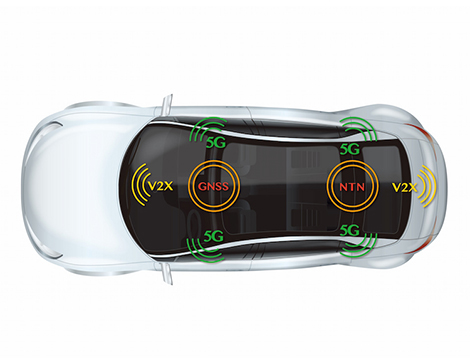
Today, AGC can integrate antennas for a wide range of wireless applications into automotive glass, from television reception and in-car navigation to keyless entry and mobile communications. The company has also developed a technique that replaces copper wires embedded in glass with antenna traces printed using conductive silver paste and then fired onto the glass. The process delivers high antenna performance, allows greater design flexibility and is now widely used in automotive glass antennas.

Kiyoshi Nobuoka
Director, Mobility Connectivity Business Development, Marketing Office, Automotive Company, AGC Inc.
Automotive windows and Shinkansen windows are designed to meet very different demands. “We had years of experience developing and supplying windows for Shinkansen trains, as well as integrating transparent antennas into automotive glass,” said Kiyoshi Nobuoka of AGC, who proposed the technology to JR Central. “But bringing the two together was a first for us. We knew from the outset that Shinkansen windows had to meet stringent standards for strength and quality, and adding an antenna would be no simple task. Still, we saw an opportunity to bring transparent antenna technology to new applications. It was a challenge worth taking on.”
Around 2020, AGC proposed its 5G glass antenna as a way to improve onboard connectivity. JR Central was also considering a range of other solutions from different companies. After conducting field tests on actual trains to evaluate antenna performance and other factors, JR Central ultimately chose AGC’s technology.
What tipped the scales in AGC’s favor? “AGC understands the technical demands of railway windows, and we believed it had the expertise to overcome the challenges of integrating this new technology,” said Ito, who was involved in selecting the development partner.
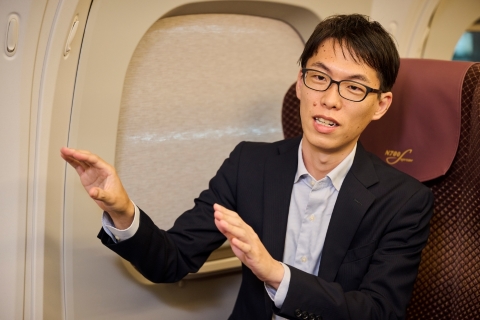
Naoki Hashimoto
Manager, Functional Solution Group, Technology Development Management Division, Asia General Division, Automotive Company, AGC Inc.
Like aircraft, Shinkansen trains are designed with airtight cabins to minimize passenger discomfort from sudden changes in air pressure when entering tunnels or passing oncoming trains inside them. As external pressure fluctuates, the train body expands and contracts, placing repeated stress on the windows. The glass must also withstand weathering and vibration. Integrating an antenna must not compromise any of these essential requirements.
The 5G glass antenna adopted for Supreme Class was custom-designed for Shinkansen windows. “We had to find a way to integrate a high-performance antenna without compromising the durability and airtightness of Shinkansen windows. We also needed to make sure the windows would be easy to replace, while keeping modifications to the train body to a minimum,” said Naoki Hashimoto of AGC, who worked on the antenna’s development. “To make this happen, our antenna and mechanical design teams worked closely with JR Central and the train manufacturer, coordinating their efforts to develop a solution that met all the requirements.”
AGC also paid close attention to the design and placement of the antenna elements to preserve the view from the train. Using a fine conductive mesh made the elements less visible. But their placement posed another challenge. Sound barriers along the railway line naturally draw passengers’ eyes toward the upper part of the window—the very area where the antennas needed to be positioned for better performance.
“Finding the right position for the antenna without compromising the view or its performance took a lot of trial and error,” Hashimoto recalled. “Working with JR Central, we fine-tuned its placement down to the millimeter, testing different seating postures and head positions to strike a balance between the two.”
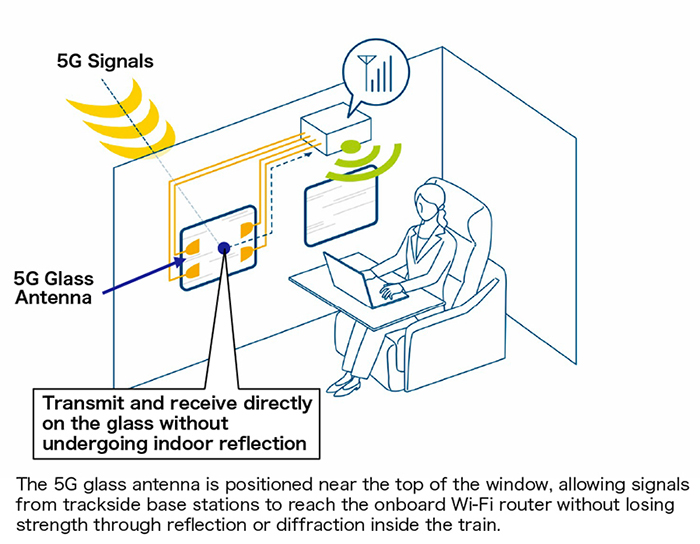
The 5G glass antenna is positioned near the top of the window, allowing signals from trackside base stations to reach the onboard Wi-Fi router without losing strength through reflection or diffraction inside the train
The antenna was installed on a 16-car N700S Shinkansen test train (J0 trainset) and tested repeatedly between Tokyo and Shin-Osaka to evaluate its performance. The tests showed that it provided a more stable connection, even along sections of the route where conventional rod-shaped antennas had experienced signal degradation.
JR Central plans to continue expanding its premium seating options on the Shinkansen. In addition to Supreme Class Cabin, a fully private compartment scheduled to debut in October 2026, the company plans to introduce Supreme Class Seat, a semi-private option, during fiscal 2027. Both will feature AGC’s 5G glass antenna technology to provide more reliable connectivity, whether passengers are working, enjoying entertainment or looking up travel information as they explore Japan.
For critical infrastructure like the Shinkansen, where safety and reliability come first, operators tend to be cautious about adopting new technology that could introduce new risks. “We’re constantly exploring new technologies to meet society’s changing needs and create new value,” Ito said. “The 5G glass antenna is one example. We’ll continue to embrace new technologies, but only after thoroughly assessing their safety.”
For AGC, the future lies in combining its expertise in glass, chemicals and electronics to give materials new functions and value. Nobuoka reflected on what the company hopes to achieve next.
“We’ve spent decades exploring new possibilities for glass,” he said. “This project reminded us that even something as familiar as a Shinkansen window still has the potential to offer new value. We want to keep pushing the boundaries of what window glass can do, developing technologies that make travel more comfortable and convenient.”
Product Information: AGC’s Transparent 5G Glass Antenna for Railways:
https://www.agc.com/en/products/automotive/5g-glass-antenna/index.html
Press Release: AGC’s Transparent 5G Glass Antenna Selected for Dedicated Wi-Fi Service in Premium Seating on the Tokaido Shinkansen N700S:
https://www.agc.com/en/news/detail/1211054_2814.html
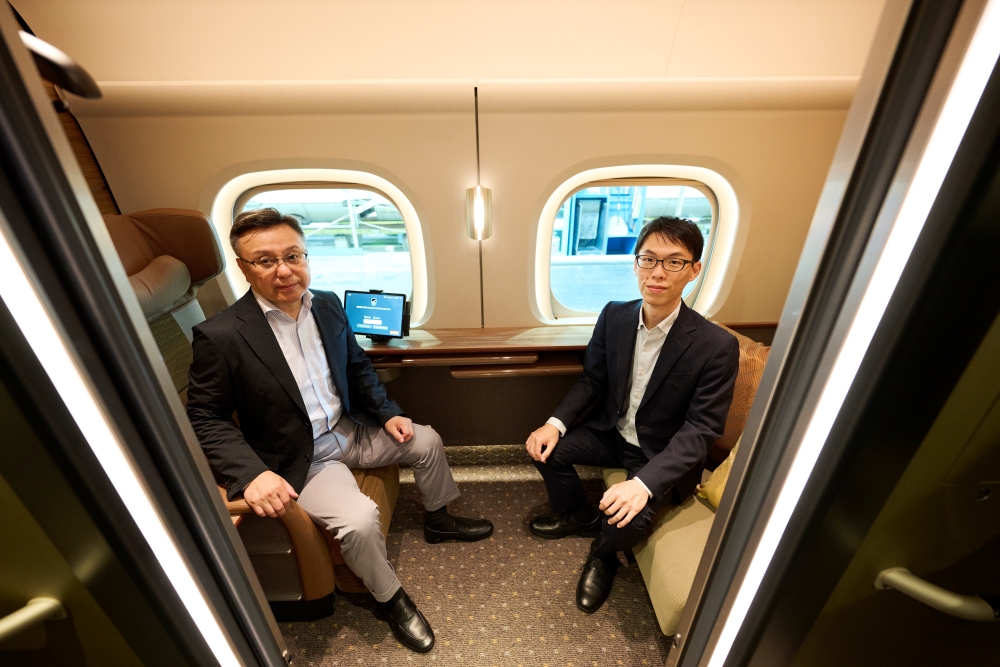
Reprinted from editorial advertisement in Nikkei Business Online Edition, September 2026
Note: Department names and job titles are as of the time of the interviews.
Technologies mentioned
in this article
Adopted on the Tokaido Shinkansen AGC’s Transparent 5G Glass Antenna
5G Sub6 Glass Antennas