

Waveguide Materials | High-Refractive-Index Glass for AR/MR Glasses
As AR/MR glasses approach widespread adoption, waveguide performance has become a critical factor that significantly shapes the user experience. There is a wide range of challenges to address, including achieving optical performance—such as a wide field of view and high brightness—balancing wearability with industrial design, and ensuring durability and mass manufacturability.
Against this backdrop, high-refractive-index glass is attracting increasing attention. Combining outstanding optical characteristics with long-term stability, this glass material is playing an increasingly important role in solving the challenges facing next-generation devices.
Technical challenges in waveguide development and manufacturing for AR/MR glasses
What is a waveguide?
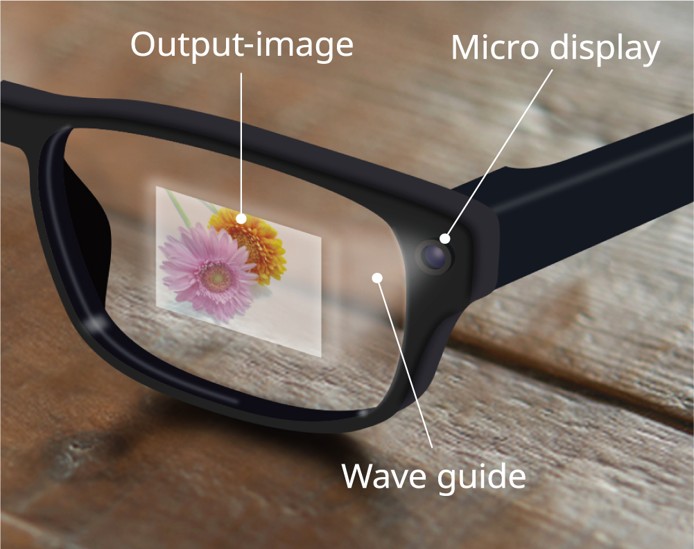
In AR/MR glasses, a waveguide transmits display light by confining it through total internal reflection, allowing digital images to be naturally overlaid in front of the user’s eyes. Light is introduced and expanded through input and output couplers, enabling images to be added to the real-world view without visual discomfort.
Furthermore, the design of diffraction gratings and holographic structures makes it possible to achieve a wide field of view and high image quality, while also ensuring sufficient brightness and color reproduction for outdoor use.
Waveguides are a key technology that supports the miniaturization and lightweight design of AR/MR glasses and enables a comfortable user experience.
Ensuring optical performance, including a wide field of view (FoV) and high image brightness
In waveguide development, one of the greatest challenges is achieving both a wide field of view and sufficient brightness. As the field of view is expanded, light propagation paths become more complex, making it easier for issues such as reduced resolution, distortion, and color shift to occur. In addition, high brightness is essential for outdoor use, but optical losses during light guiding tend to reduce image brightness.
Here, material properties such as transmittance and light-scattering characteristics have a major impact, with transparency and low optical loss directly determining performance. For this reason, optimizing material selection is essential.
Balancing wearability and product design (optimizing thickness and weight)
Lightweight and thin designs are common challenges across all AR/MR glasses, and the waveguide is a key contributor to overall thickness and weight.
Material density and rigidity directly affect comfort when worn and design flexibility. Even when achieving the same optical performance, different materials can significantly change the look, feel, and usability of the device. Therefore, to meet the overall design requirements of the glasses, a structural design that takes waveguide material properties into account is indispensable.
Ensuring durability (heat, moisture, and scratch resistance)
Long-term reliability, such as heat resistance, moisture resistance, and scratch resistance, is another critical challenge for AR/MR glasses. Among their components, the waveguide is particularly important because it is directly exposed to the external environment during use.
Material stability and surface characteristics have a major influence on durability. Resistance to humidity and temperature changes, as well as to abrasion and impact in everyday use, directly affects product lifespan. Consequently, in addition to careful material selection, combining surface treatments and reinforcement technologies is required to enhance the overall reliability of the glasses.
Advantages of using high-refractive-index glass as a waveguide material
Comparison with other materials
Glass offers excellent optical performance and durability, but its drawbacks include weight and low resistance to impact. At present, materials tend to be selected based on application priorities: glass is chosen when high performance is paramount, polymers when lightweight design and aesthetics are emphasized, and crystalline materials for specialized, high-precision applications.
| Property | Glass | Resin (polymer) | Crystal (mainly SiC) |
|---|---|---|---|
| Optical performance | High refractive index and high transmittance | Medium refractive index; color aberration can be an issue, especially for wide FoV | Very high refractive index and unique wavelength properties |
| Durability | Highly resistant to wear and aging, but prone to breakage | Resistant to breakage, but vulnerable to wear, UV exposure, and humidity | High durability, but inherently brittle |
| Processability | Moderate hardness allows high-precision polishing; offers the best overall processability | Suitable for injection molding | Difficult to process; high cost |
| Productivity | Relatively suitable for mass production (polishing process required) | Easily mass-produced via injection molding | Difficult to process; not suitable for mass production |
| Environmental resistance | High | Low (sensitive to humidity and UV) | High |
Wide FoV with a thin profile for greater design freedom
Glass offers high transparency and optical stability, and it can be processed into thin substrates while still maintaining sufficient strength. In contrast, polymers can struggle to retain their shape when thinned, which can impose constraints on optical performance and appearance.
While certain optical characteristics are easier to achieve with some thickness, excessive thickness increases weight, so it is essential to balance strength, optical performance, and lightweight design.
The demand for thinner designs is largely driven by industrial design requirements. By using glass substrates, it is possible to achieve a stylish design and comfortable wearability while still delivering a wide field of view and an immersive visual experience.
Low moisture absorption, high rigidity, and chemical resistance
Compared with polymers, glass has much lower moisture absorption, resulting in minimal dimensional changes or degradation of optical properties from humidity fluctuations.
Its high rigidity also makes it resistant to deformation and warpage, helping maintain optical performance over the long term. In addition, excellent chemical resistance reduces the impact of external environments, providing high reliability in everyday use.
High-refractive-index glass from AGC
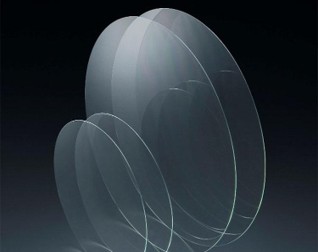
AGC’s high-refractive-index glass substrates offer all the properties required for a wide field of view and high image clarity. This makes them ideal for next-generation AR/MR glasses and head-up displays.
Wide field of view enabled by a high refractive index
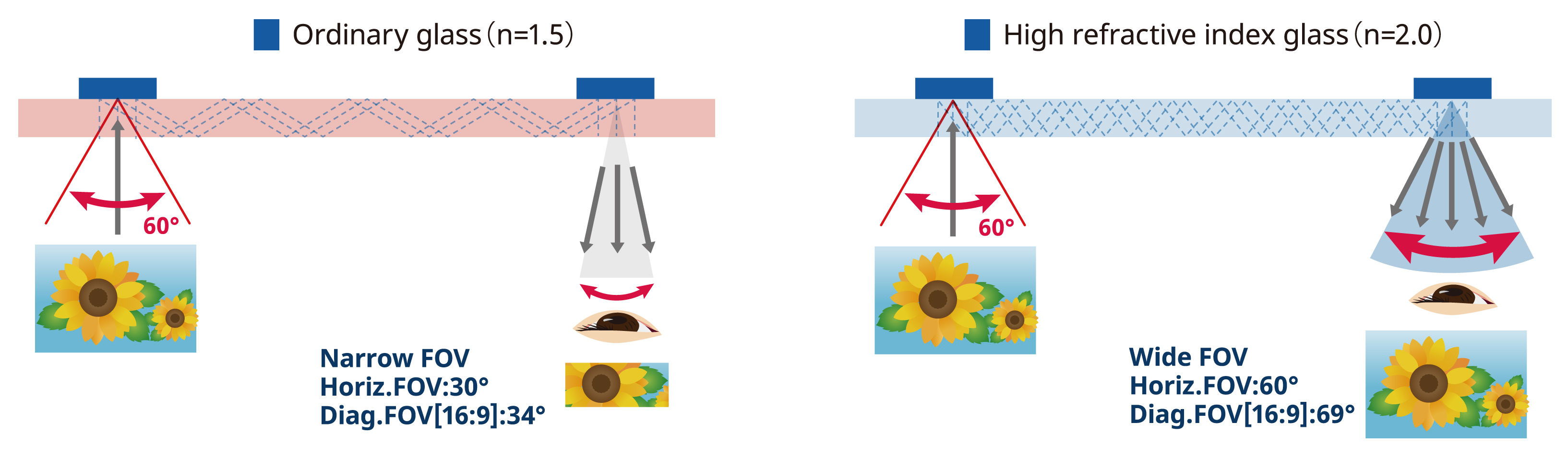
Our high-refractive-index glass (n>1.7) expands the critical angle for total internal reflection, enabling a wider field of view than that of conventional materials. This significantly enhances immersion in AR glasses and head-up displays, improving the overall user experience. By enabling a field-of-view expansion that is difficult to achieve with standard optical glass, it provides greater design freedom for next-generation waveguides.
Clear image propagation enabled by high transmittance and optical quality

In addition to an internal transmittance of 95% or higher, our glass achieves high-precision processing with TTV ≤ 0.5 µm and surface roughness ≤ 0.5 nm. This minimizes losses during light guiding and maximizes image brightness, color reproduction, and resolution. Glass’s inherently high optical homogeneity also helps reproduce images through the waveguide without distortion, enabling the clear and natural viewing experience required for AR/MR devices.
Related information
Development of high-refractive-index glass wafers for AR/MR glasses
This paper reports on the development of high-refractive-index glass wafers (M100) optimized for AR/MR glasses. Through innovations in composition design and melting technology, the wafers achieve high transparency and light weight while maintaining excellent optical performance.
“M100/200 Series” recognized in the XR category of the CES 2025 Innovation Awards®
AGC’s M100/200 Series was recognized in the XR category of the CES 2025 Innovation Awards®. The series was highly evaluated as a next-generation optical material that significantly enhances the field of view, image clarity, and image accuracy of AR/MR glasses, thanks to its transparency, refractive index, and uniform surface quality.
Product Inquiries & Information Requests